
Learn
About StarCore, SMRs & Nuclear Power
Nuclear energy is complex, and we encourage an open dialogue where every question and concern is worth exploring. We have put together clear and honest information below to show how our technology can power cleaner, more resilient communities and industries.
Frequently Asked Questions
SMR Basics
What is nuclear power?
As in many other power plants, heat is used to boil water, creating high-pressure steam that spins a turbine creating the electricity that goes out to the grid and into your home.
In gas plants this heat comes from burning fossil fuels. In a nuclear power plant, the heat comes from splitting uranium atoms (nuclear fission). Uranium holds an incredible amount of energy in a tiny package. One small, 10 gram fuel pellet the size of your fingertip can produce as much electricity as 1 ton of coal or 17,000 cubic feet of natural gas.
To learn more, please visit the International Atomic Energy Agency.
What are Small Modular Reactors (SMRs) and how are they different from large plants?
Small: Traditional nuclear power plants typically produce around 1,000 MWe (enough to power about 750,000 homes) and have a footprint of around 3.4 square kilometers (630 American football fields). SMRs produce much less electricity, ranging from 10 to 300 MWe (7,500 to 225,000 homes).
SMR designs vary, but each StarCore base unit produces 10 MWe (7,500 homes) in a facility around the size of two American football fields (three acres). We can scale up the power output without increasing the footprint to meet the needs of larger communities.
Modular: Instead of being designed from scratch for every project and built on site over 10+ years, SMRs’ fundamental footprint remains the same and are designed for specific applications. All of their components are built in factories and shipped as modules. These “modules” are then shipped to the construction site where they can be assembled and operational in 2-3 years.
StarCore’s SMRs are designed specifically to meet the needs and limitations of very remote locations.
Reactors: SMRs are still based on splitting uranium atoms to create heat and spin a turbine, just like the big nuclear plants. StarCore’s reactors are based on a technology that does not need or use water in its production of electricity.
Why should we pick an SMR over diesel generators or renewable energy?
Diesel generators are generally reliable but they are noisy, their emissions are harmful, the price of fuel is unpredictable, and the delivery can be affected by weather.
Renewable energy like wind and solar is clean but highly dependent on the weather and takes up a large amount of space. Renewables often require back up by diesel or batteries that have very limited supply capacity.
Small Modular Reactors bring 24/7 baseload power and produce zero emissions during operation. Reactors only require refueling once every 10 years.
In addition to electricity, SMRs also produce very high temperature heat. This “cogeneration” can power other community benefits such as water purification, indoor agriculture, hydrogen fuel production, and local heating.
What is unique about StarCore’s SMR design?
StarCore’s SMR is a High-Temperature Gas-Cooled Reactor (HTGR). Instead of water, it uses helium to transfer heat from the nuclear reactor to an air breathing (aero-derivative) turbine.
This brings many benefits:
- Siting flexibility: Our SMR can be built in rugged or very dry locations since we don’t need to use local water sources.
- Secondary applications: Our SMR generates electricity and heat, a powerful combination that can enable indoor agriculture, water purification, hydrogen fuel production and more.
- Walk-away safe: In the event of a disruption, the reactor safely shuts down without external power or human intervention, and cannot “melt down”.
Our SMR is also unique in that it is designed for the most remote communities. This includes modules that are small enough to transport without damaging rural roads, parts that are easy to source to simplify maintenance, and more.
Why are SMRs a good fit for remote communities?
SMR’s are an “all-in-one” solution. They provide safe and reliable power, do not take up a lot of space, and enable other local businesses to develop with affordable power.
Remote communities are largely reliant on diesel generators. In addition to their noxious emissions, these are expensive to maintain and operate, noisy, and often unreliable.
SMRs are quiet. reliable, consistent power providers, and only require refueling every 10 years. They do not need much land and will provide both electricity and heat. The high quality heat, air above 300C, can purify water from any source, such as ground water, salt water, grey water, to produce potable water on a consistent basis that meets the highest standards.
SMRs will be additive to the community, not just a source of electricity. New businesses can use the lower cost power, heat and water to grow food, feed for animals, and a range of services that were not accessible.
Safety and Environment
What is a meltdown and how will you prevent this from happening?
Even after a nuclear power plant is turned off, the fuel stays very hot. A nuclear meltdown happens when the cooling system fails and the heat from the reactor starts to melt the structure that contains it, releasing radiation into the environment.
StarCore’s SMR uses helium instead of water to remove heat from the reactor core and unlike water, the helium cannot become radioactive, ever. It cannot have the same problems as water-cooled reactors like Chernobyl and Fukushima. The International Atomic Energy Agency has assessed that HTGR’s are “inherently safe”.
Additionally, our SMRs will use a special type of incredibly safe fuel. Known as TRISO, each grain of uranium is encased in three layers of highly resilient layers. These tiny “pebbles”, each of which is the size of a poppy seed, keep radioactive materials locked inside even at temperatures exceeding 1800°C.
If the helium is cut off to the reactor, or some unexpected event forces the helium out, the tiny pebbles stop reacting. They literally go to sleep and they remain inactive. This is known as being “walk away safe”.
Read more on our blog about how our design is inherently safe.
Should I be worried about radiation?
Radiation comes from natural and man-made sources, and we are all subjected to it every day.
The amount of radiation absorbed by the human body is measured in “sieverts”, with one sievert being a very large dose. Most natural and man-made sources emit much less and are measured in “millisieverts” – 1/1000 of a sievert – abbreviated as mSv.
The recommended annual dose limit for the general public is 1 mSv according to the International Commission on Radiological Protection (ICRP). Radiation sickness occurs around 1,000 mSv, and a lethal dose is 5,000 mSv.
To put this into perspective:
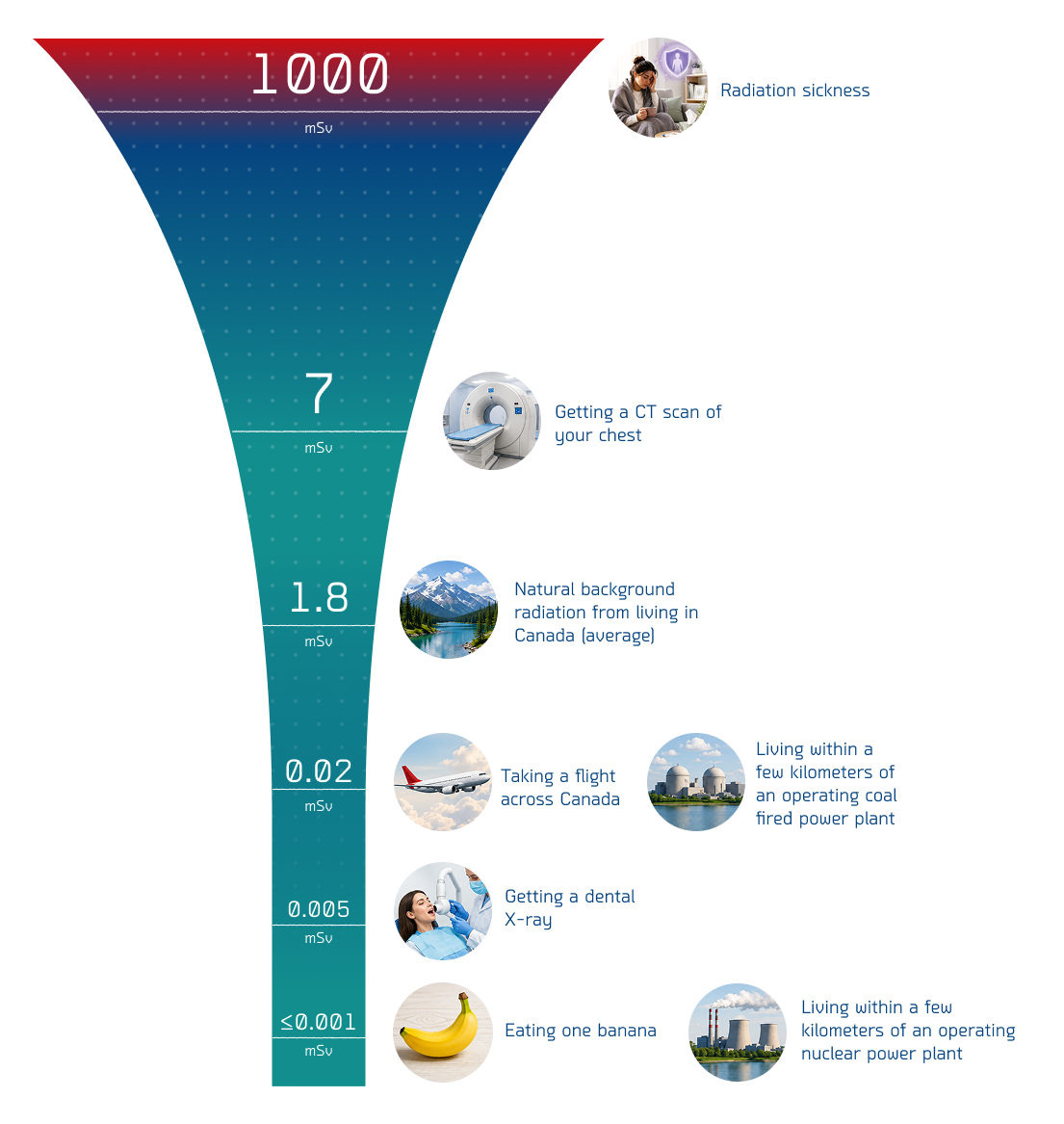
- Getting a CT scan of your chest: 7 mSv
- Natural background radiation from living in Canada (average): 1.8 mSv
- Taking a flight across Canada: 0.02 mSv
- Getting a dental X-ray: 0.005 mSv
- Eating one banana: 0.001 mSv
- Living within a few kilometers of an operating nuclear power plant: 0.001 mSv
- Living within a few kilometers of an operating coal fired power plant: 0.02 mSv
It is important to be mindful of radiation exposure, but nuclear power plants contribute very little to your overall total.
To learn more, please visit the Canadian Nuclear Safety Commission.
Do SMRs pollute the air or produce greenhouse gases?
Nuclear power plants only release steam or heat, not smoke, particulate matter or CO2.
Because StarCore’s SMR is cooled with helium and generates power with a gas turbine, it only releases heat and hot air, all of which can be used for other purposes such as water purification, indoor farming, and more. Any remaining heat is recycled in the feed to the air breathing turbine.
There are emissions related to mining, construction, and disposal, which is true of any power source. SMRs represent a fraction of diesel’s lifecycle emissions. Nuclear power has the lowest life-cycle emissions compared to all other power sources – hydro, renewables, solar, and others.
Will an SMR harm our environment and local wildlife?
According to a United Nations commission, the power sources with the lowest impact on ecosystems are roof-mounted solar panels and nuclear energy.
StarCore’s helium-cooled Small Modular Reactor emits zero emissions during operations, does not connect to local waterways, emits less radiation annually than a single X-ray, and has a footprint of only three acres.
All sources of power have some environmental impact, but SMRs minimize this impact in all categories more than any other option.
What will you do with the nuclear waste?
When used up (“spent”) fuel is removed from the reactor, it needs to cool down on-site, where it is stored in rugged containers called “dry casks”. These are made of thick layers of reinforced concrete and steel that are designed to withstand extreme events like earthquakes, floods, and even aircraft impacts. They have been used for over 50 years without incident or failure. They use passive cooling, are monitored by the Canadian Nuclear Safety Commission, and can safely hold waste for at least 50 years.
These will eventually be moved to permanent storage. Canada’s Nuclear Waste Management Organization is currently in the early stages of selecting a site to build a Deep Geological Repository (DGR) for the fuel and other waste that will be produced by Small Modular Reactors for thousands of years.
Rights and Regulations
Who makes the final decision on whether an SMR is built?
Assuming that a site is feasible for a Small Modular Reactor project, the three elements that are required to build are a license from the federal regulator, an agreement to purchase the electricity produced by the SMR, and community consent.
Does our community have to say "yes"?
No. Consent is a choice. If a community decides the risks outweigh the benefits, they have the right to oppose the project.
Who is responsible if there is an accident or environmental damage?
In most countries, the company operating the reactor is legally responsible and will be required to pay for any damages. If they cannot pay, many governments, such as Canada, have a fund to ensure the land is protected and people are compensated.
High-Temperature Gas-Cooled Reactors have operated in various countries since the 1960s, including the US, the UK, and others. The technology has improved significantly since then, and the International Atomic Energy Agency now describes them as “inherently safe”.
There are currently HTGRs with clean safety records operating in Japan and China. Multiple tests have proven their ability to safely and automatically shut down when their cooling systems are interrupted.
Community Impact
Will there be more or less jobs if my community switches to nuclear power?
Any change in total employment directly related to power generation will have to be evaluated on a case-by-case basis.
More broadly, a Small Modular Reactor may bring a surplus of affordable heat and power to a community, enabling new business opportunities and added community infrastructure that were previously limited by the cost and availability of electricity.
The heat generated by StarCore’s SMR also opens up new possibilities for locally-owned, job-creating infrastructure such as indoor agriculture, animal feed lots, water treatment facilities and hydrogen fuel production.
Will my electricity bill go up or down?
This is highly dependent on the current price of electricity and the details of the final agreement, but the intention is for your electricity to cost less. Generally, electricity costs will be reduced, as diesel powered electricity is universally expensive off-grid.
Additionally, Small Modular Reactors have predictable fuel costs, bringing long-term stability to your energy bills that is not possible with volatile fossil fuel prices and fluctuating carbon taxes.
What happens when the SMR needs to be permanently shut down?
StarCore is responsible for, and enthusiastically committed to, fully restoring the site to a safe, natural state.
Before any license is approved or shovel touches the ground, StarCore is legally obligated to provide a detailed plan and financial guarantees for decommissioning our facility. This means that even if something happens to our company, there is money set aside to shut down the power plant and remove the fuel, components and operations from the site.
What other opportunities will a StarCore SMR bring to my community?
Our Small Modular Reactor produces consistent, reliable electricity around the clock in any weather, bringing stability to local infrastructure. Depending on your current power source, it may even bring a surplus of electricity, enabling new facilities such as community centres or new businesses.
In addition to electricity, our SMR also produces very high temperature heat. This can be used to purify water, support aquaponic and hydroponic farms, or open up new industries such as mineral processing or hydrogen production, all with minimal impact to the electricity available for the community.
We also bring increased digital connectivity. Each of our SMRs is monitored remotely by a network of satellites, but we only need about 1% of the bandwidth that is available. We are offering the remainder to our host communities free of charge and will work with local leadership to use it for a priority service such as telemedicine or remote education.
I. SMR Specifics
II. Nuclear Notes
III. Secondary Services
IV. Community Questions
V. Policies & Positions
VI. Future Frontiers
Have questions? We'd love to hear from you.
